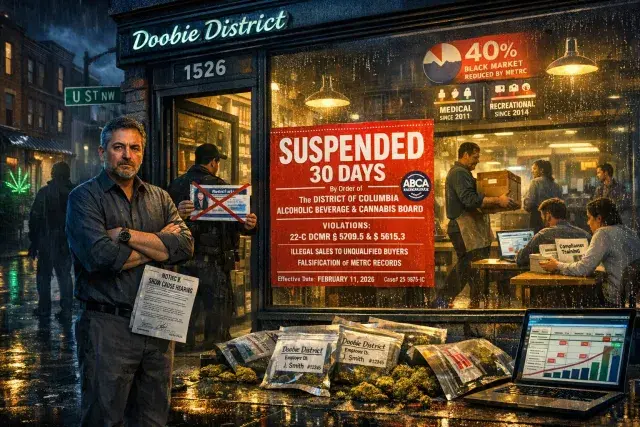
The District of Columbia Alcoholic Beverage and Cannabis Board has imposed a 30-day suspension on KLM, LLC, operating as Doobie District, for illegally selling medical cannabis to unqualified individuals and falsifying records in the state's METRC tracking system. Issued on February 11, 2026, this ruling underscores the critical need for strict compliance in DC's medical cannabis program, protecting patient access while preventing diversion to unregulated markets.
Investigation Reveals Serious Compliance Failures
An ABCA investigation, triggered by tips on May 9, 2025, exposed lapses at the 1526 U Street, NW location. Undercover agents made two controlled buys of medical cannabis without showing patient cards or caregiver verification, a direct violation of 22-C DCMR § 5709.5. Packages bore labels with a Doobie District employee's name and ID, not the buyers', and analysis showed that employee's METRC account exceeded the 8-ounce monthly patient limit, with two other accounts similarly oversold.
- Staff failed to verify medical registration before sales.
- False METRC entries breached 22-C DCMR § 5615.3, undermining seed-to-sale traceability.
- Product was confirmed as medical-grade from licensed cultivators.
Dispensary Response and Board’s Measured Penalty
Doobie District owner Peter Murillo admitted the facts at a show cause hearing, attributing issues to rogue staff. The company fired implicated employees, retrained others, and introduced weekly oversight on sales and volumes. Despite these steps, the Board stressed licensee accountability for supervision, opting for suspension over revocation but mandating ABCA-approved training within 60 days. Non-compliance risks reimposing the penalty.
This balanced approach reflects DC's regulatory evolution: since medical cannabis launched in 2011, enforcement has tightened to match recreational sales legalized in 2014, with ABCA handling over 100 violations annually to maintain program integrity.
Implications for Patient Safety and Market Integrity
These violations highlight vulnerabilities in medical cannabis dispensing, where unverified sales risk exposing non-patients to high-THC products unregulated for recreational use, potentially exacerbating public health issues like overconsumption or impaired driving. METRC falsification erodes trust in seed-to-sale systems, designed to track from cultivation to consumption and curb black market diversion—nationwide, such systems have reduced illicit trade by up to 40% in compliant states.
In DC's dual medical-recreational market, stricter oversight prevents medical stock from flooding recreational channels illegally, ensuring equitable access for qualified patients amid rising demand. This case signals to retailers: compliance isn't optional, as negligent supervision invites severe repercussions, fostering a safer, more professional industry.