Most cannabis brands don't survive their first decade. The ones that do usually share something beyond a marketable strain name or sharp packaging - they have a coherent identity that holds up under the pressure of expansion, regulatory friction, and the inevitable wave of well-funded competitors. Cookies, the cannabis brand founded by Berner, built that identity over years of ground-level work before it became a global operation. The story is less about inspiration and more about the operational and cultural decisions that compound over time into something durable.
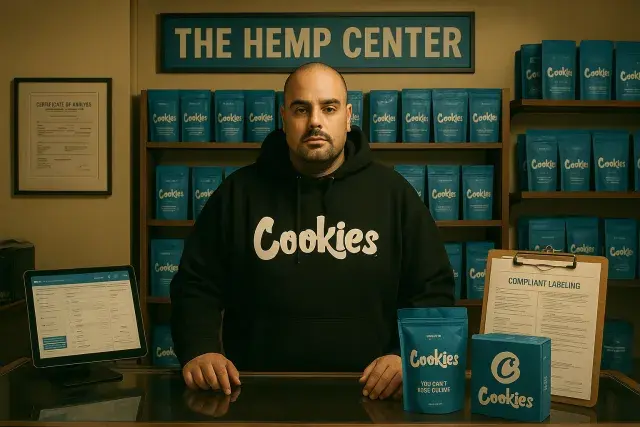
Berner's entry point was the dispensary floor - not an investor deck. Working at The Hemp Center in San Francisco in the early 2000s, he developed a firsthand understanding of the cannabis consumer that most brand founders skip entirely. That retail immersion matters more than it might seem. Operators who have spent time behind the counter - managing intake, interacting with patients, watching what products move and why - tend to make better supply chain and product decisions later. For cannabis-adjacent technology vendors and retail operators alike, the parallel is direct: tools like marijuana pos software oregon exist precisely because the dispensary floor generates more transactional and behavioral data than most operators know how to use, and operators who understand that data from lived experience extract more value from it. Berner's floor-level education gave him a consumer insight framework that he carried forward into every product and licensing decision Cookies made.
The brand's early growth relied on a licensing model that carried real risk. Placing genetics and brand identity in a partner's hands means accepting potential quality variation - a genuine operational vulnerability in a market where product testing, certificate of analysis documentation, and compliant packaging are not optional. Berner acknowledged that quality slipped in some partnerships during rapid expansion. That's an honest accounting most brand founders avoid making publicly. In cannabis specifically, where state regulators can pull licenses over labeling violations and where consumers in adult-use markets have more product choice than ever, brand equity can erode quickly if partners don't hold to the same standards. The lesson for multi-state operators and wholesale brands isn't that licensing is wrong - it's that partner vetting, contractual quality benchmarks, and ongoing oversight are the infrastructure that makes licensing viable rather than reckless.
Branding as Operational Infrastructure, Not Marketing Decoration
Berner's framework for brand-building is worth reading carefully, because it maps cleanly onto operational discipline. His three principles - staying true to the vision, maintaining iconic visual branding, and assembling a team that understands both - are not soft cultural aspirations. They're operational standards. In a regulated retail environment, inconsistent packaging costs real money: reprints, compliance reviews, potential enforcement attention. SKU proliferation without a coherent brand architecture creates inventory management problems at the POS level. Cookies' early investment in a consistent logo, colorway, and packaging language reduced those downstream headaches, even if that wasn't the explicit intent at the time.
The brand's deliberate integration of streetwear aesthetics, music, and cannabis culture also did something strategically important: it differentiated Cookies in a commodity-adjacent market. Cannabis flower, at the wholesale level, competes heavily on price and testing results. Brand-attached product can hold a price premium that unbranded or weakly branded product cannot. That premium is what funds the quality control investment, the design work, and the compliance infrastructure. Operators building private-label programs or evaluating wholesale partners should think about this dynamic directly - a brand with genuine cultural authority creates pull through the retail channel in ways that a good COA alone does not.
The $800 Million Walk-Away and What It Says About Cannabis M&A
The decision to decline an $800 million acquisition offer - primarily because the consideration was heavily weighted toward stock with uncertain long-term value - is a useful case study in cannabis deal structure. The cannabis industry has seen a significant number of high-profile acquisitions where the acquiring company's equity lost value sharply after close, leaving founders who took stock-heavy deals in difficult positions. Berner's instinct to distrust that structure reflects a hard-won understanding of cannabis capital markets that many operators learn too late.
His advice on legal diligence is equally direct: always have a lawyer review contracts, and treat anyone who says otherwise as a warning sign. In a market where licensing agreements, supply contracts, and wholesale distribution deals regularly contain provisions that transfer meaningful rights without founders fully understanding the implications, that's not a cliché - it's a minimum standard of operation. The 280E tax burden that cannabis businesses carry under federal law makes every dollar of deal structure more consequential, not less. An acquisition or licensing deal that looks favorable at the headline number can look very different after accounting for tax treatment and equity dilution.
What the Cookies Model Actually Teaches Cannabis Operators
The practical takeaways here aren't specific to hip-hop adjacent cannabis brands or lifestyle companies with entertainment crossover ambitions. They apply to any licensed cannabis business trying to build something that lasts past the next license cycle.
- Organic brand growth built on product quality and community trust is slower than paid growth, but it survives market compression better.
- Licensing and partnerships accelerate reach but require contractual quality standards and active oversight - not just trust.
- Visual brand consistency is an operational investment, not an aesthetic preference, particularly in regulated retail where packaging compliance and brand recognition overlap.
- Legal review of every material contract is non-negotiable in an industry where federal illegality creates unusual enforcement risk and unusual deal complexity.
- Rapid expansion that sacrifices quality control can be recovered from, but it carries real risk to license standing and consumer trust in the interim.
Berner's observation that "you can't rush culture" translates into business terms this way: brands that try to manufacture urgency or shortcut the product development cycle tend to lose the quality signal that justifies premium pricing. In a maturing adult-use market with significant shelf competition, that signal is one of the few durable advantages a cannabis brand can hold. Building it takes time. Losing it doesn't.