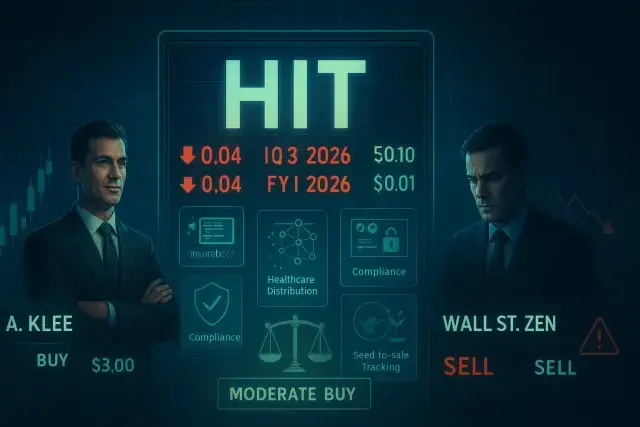
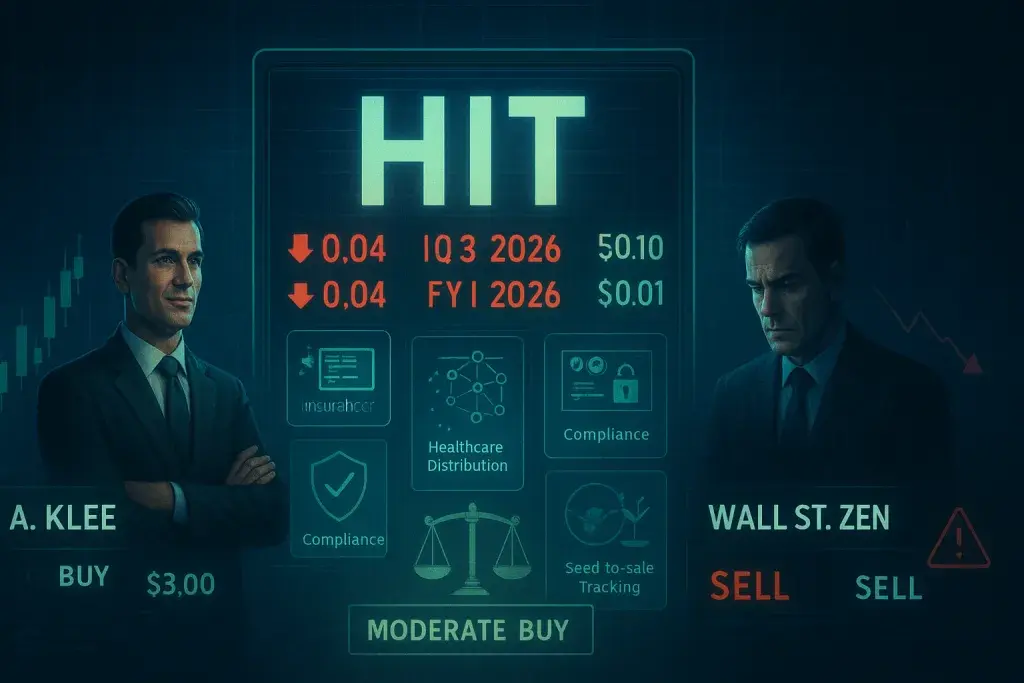
Wall Street's coverage of Health In Tech, Inc. (NASDAQ: HIT) is turning into a study in contrasts. Maxim Group analyst A. Klee issued a fresh round of estimates on Friday, August 14th, projecting a per-share loss of $0.04 for the third quarter of 2026, alongside a full-year 2026 loss forecast of $0.10 per share. The firm kept its "Buy" rating intact with a $3.00 price target, betting that the insurtech company's path toward profitability - projected to include a modest $0.01 per-share gain in Q1 2027 before dipping back into loss territory later that year - will eventually pay off for shareholders willing to stomach near-term volatility.
Health In Tech operates at the intersection of insurance technology and healthcare distribution, a sector that, like regulated cannabis retail, lives and dies by compliance infrastructure, data accuracy, and the ability to process transactions cleanly at scale. That parallel is worth noting for anyone watching adjacent regulated industries: just as a dispensary depends on dependable back-end systems - the kind of infrastructure seen in platforms offering cannabis retail point of sale new mexico operators rely on for seed-to-sale tracking and tax reporting - health-tech platforms depend on their own transactional backbone to keep brokers, insurers, and consumers connected without friction. The comparison isn't incidental. Both sectors are navigating regulatory complexity while trying to convince investors that near-term losses are the cost of building something durable.
A Divided Analyst Picture
Not everyone on Wall Street shares Maxim Group's optimism. Wall Street Zen downgraded the stock from "hold" to "sell" back in April, while Weiss Ratings has held firm on a "sell (d)" grade as recently as late June. Craig Hallum, on the other hand, initiated coverage in April with a "buy" rating and an even higher price target of $4.00. That's a fairly wide spread of opinion for a single small-cap name - one analyst sees a "Strong Buy," another lands on "Buy," and a third calls for "Sell." The result, per MarketBeat's aggregation, is a consensus "Moderate Buy" rating with an average target price of $3.50, a number that essentially splits the difference between the bulls and the skeptics.
Here's the catch with per-share loss estimates stretching out multiple fiscal years: they tell you a lot about analyst confidence in eventual scale, but very little about the operational grind required to get there. Maxim's own numbers show Health In Tech inching toward breakeven by early 2027 before slipping again - a pattern that suggests lumpy revenue recognition or seasonal cost pressure rather than a straight line to profitability.
Why the Spread Matters
For investors and industry watchers alike, a wide dispersion between "sell" and "buy" ratings on the same stock, with price targets ranging from $3.00 to $4.00 among the bulls, signals genuine disagreement about business fundamentals rather than simple noise. In practice, though, that kind of split isn't unusual for smaller-cap technology names still working to prove out a business model. What's striking here is the sheer volume of coverage for a company still posting losses on nearly every quarterly line Maxim has modeled out through 2027 - a sign that whatever Health In Tech is building, it's attracting enough institutional attention to warrant real scrutiny, even if that scrutiny hasn't produced consensus.