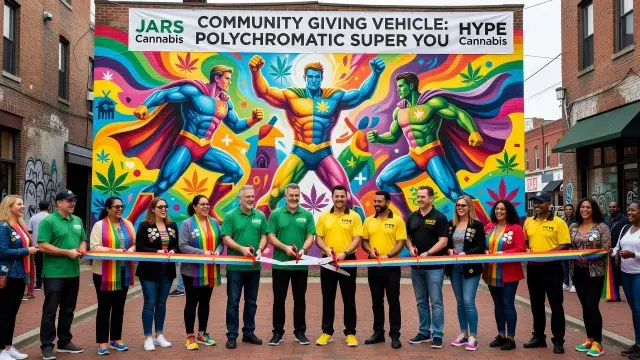
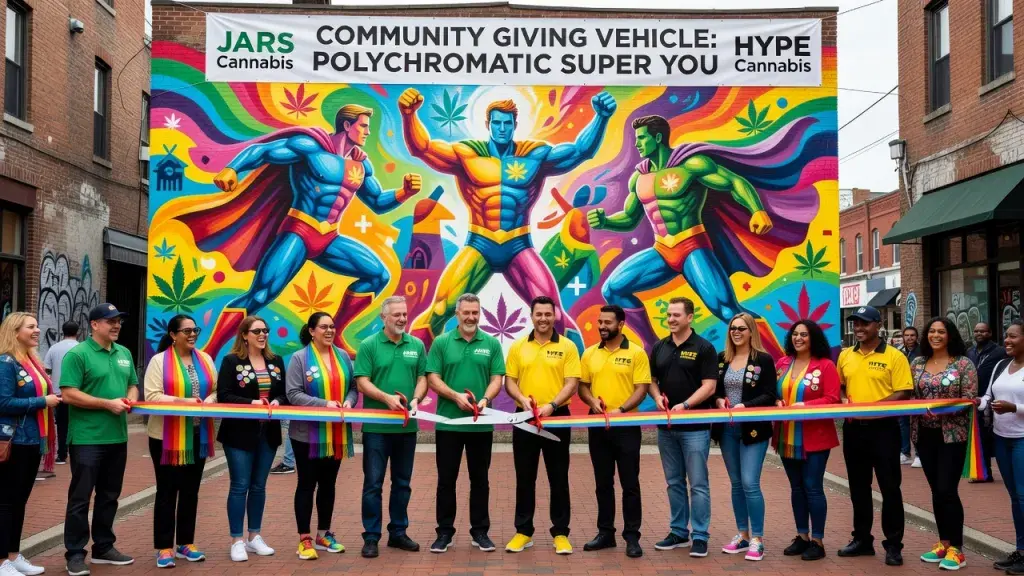
Two Michigan cannabis retailers just demonstrated a marketing move that doubles as a community investment: a permanent mural instead of a limited-run promotion. JARS Cannabis and HYPE Cannabis held a ribbon-cutting this week for "Polychromatic Super You," a 40-by-25-foot piece by Michigan artist Joey Salamon, installed in an alley off W. Nine Mile Rd. in downtown Ferndale. The mural anchors the companies' Smoke with Pride campaign, which directs a share of proceeds to Detroit's Ruth Ellis Center, a support organization for at-risk LGBTQ+ youth.
For dispensary operators watching from outside Michigan, the mechanics here matter more than the ribbon-cutting photo op. Ten percent of proceeds from HYPE products sold at JARS locations, plus 100 percent of proceeds from a dedicated JARS x HYPE Smoke with Pride Kit, flow to the Ruth Ellis Center. That's a SKU-level charitable allocation baked directly into the point-of-sale system, not a vague pledge tacked onto a press release. Running that kind of split accurately requires POS infrastructure capable of isolating specific product lines at checkout and reconciling donation totals against sales data, the same operational backbone that underpins broader retail compliance work. Multi-state operators exploring similar cause-marketing tie-ins would do well to look at how platforms built for regulated cannabis retail, including a cannabis ecommerce platform missouri operators use for order management and reporting, handle promotional SKU tracking without disrupting seed-to-sale compliance. cannabis ecommerce platform missouri
Why Public Art Is Becoming a Compliance-Friendly Marketing Channel
Cannabis advertising rules remain restrictive in most states, limiting billboards, broadcast spots, and even some digital placements near schools or parks. Public art occupies a gray zone that many operators are learning to use well. A mural funded by two license holders but installed on a private wall, with a QR code linking to a donation page rather than a menu or discount code, sidesteps a lot of the advertising restrictions that govern direct product promotion. It's brand visibility without a price tag or a strain name in sight. That distinction matters to compliance teams, because state marketing regulations generally treat product advertising and corporate philanthropy differently, even when the same company logo appears on both.
The Business Logic Behind Cause-Linked Retail Campaigns
Retailers operating under 280E already carry a heavier tax burden than most small businesses, since federal law bars standard deductions for companies trafficking in a Schedule I substance. Margins get squeezed further by state excise taxes, compliant packaging costs, and lab testing fees tied to every batch moving through inventory. Against that backdrop, a cause campaign that ties a modest percentage of proceeds to a nonprofit isn't just goodwill; it's a low-cost differentiation strategy in a wholesale and retail market where price competition alone rarely builds loyalty. The QR code strategy also gives JARS and HYPE something harder to fake: a direct, trackable link between foot traffic, community engagement, and donation activity, which matters when a company wants to show its Smoke with Pride numbers are more than a press release line.
What Other Operators Should Take From This
- Charitable tie-ins tied to specific SKUs require POS systems that can isolate and report on those products cleanly for both accounting and compliance audits.
- Public art and mural sponsorships generally fall outside strict cannabis advertising statutes, but operators should confirm local zoning and sign ordinances before assuming a mural is exempt from review.
- QR-code philanthropy only works if the landing page is maintained; a broken donation link undermines the credibility of the entire campaign.
- Partnering with a local artist and a regional nonprofit builds goodwill that a straightforward discount promotion cannot replicate.