Glass House Brands has applied to list its subordinate voting shares on the New York Stock Exchange - a move that required the California-based cannabis company to execute a significant structural reorganization before the NYSE would even consider the application. The mechanism at the center of that reorganization is what the company calls a "deconsolidation transaction," which legally separates its adult-use cannabis retail business from its medical cannabis operations. The split isn't cosmetic. It reflects a fundamental regulatory constraint that continues to wall off the NYSE - and most major U.S. exchanges - from cannabis companies with direct exposure to federally illegal plant-touching operations.
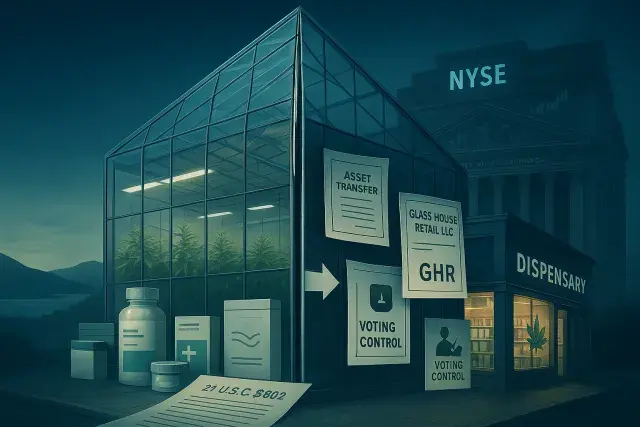
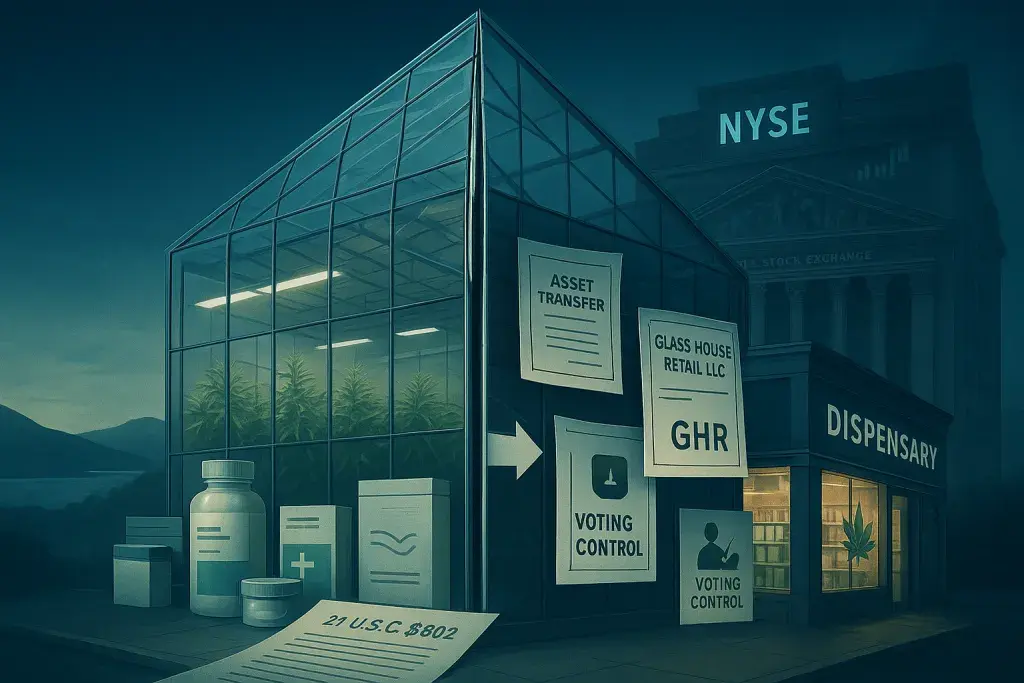
The structure Glass House built is worth understanding in some detail, because it signals a template other multi-state operators and vertically integrated cannabis companies may study closely. Under the deconsolidation, the company's indirect wholly owned subsidiary, GHB Usub LLC, transferred the dual-use retail business into a new entity - Glass House Retail LLC (GHR) - while retaining only non-voting, non-participating units in that entity. Voting control of GHR sits with a third-party investor, which means Glass House no longer consolidates the financials of its adult-use operations under standard accounting rules. That's the bridge: strip out the federally prohibited business from the consolidated financials, and the parent company becomes, at least structurally, a medical cannabis operation that an exchange can list without violating its own federal compliance obligations. Operators across the country managing dual-use licenses and multi-state retail footprints - including those wrestling with the same financial infrastructure questions that drive demand for tools like a cannabis dispensary pos system alaska - are watching this kind of capital markets architecture with genuine interest, because access to public equity changes the economics of everything from real estate to technology investment.
Here's the catch, though. The non-voting units Glass House holds in GHR can only convert back into voting units - effectively reunifying the business - once the NYSE itself changes its rules to permit the listing of companies that consolidate the financials of entities engaged in cultivating, distributing, or processing marijuana as defined under federal law, specifically 21 U.S.C. § 802. That's not a minor technical footnote. It means the full corporate reunification is contingent on federal rescheduling, de-scheduling, or some form of exchange-level policy shift that no one can schedule on a calendar. Several businesses that were transferred as part of the dual-use operation are also pending regulatory approval before they formally transfer to GHR - those transfers happen automatically upon receipt of that approval, without any further action required by Glass House or its counterparties.
What the NYSE Constraint Actually Means for Cannabis Capital
The NYSE's position isn't arbitrary. Under federal law, marijuana remains a Schedule I controlled substance, and the exchange operates under SEC oversight. Listing a company that consolidates the financials of a federally illegal plant-touching business creates regulatory exposure the exchange isn't willing to accept - at least not yet. That's why every major U.S.-listed cannabis company with significant plant-touching operations has historically traded on Canadian exchanges like the TSX or on over-the-counter markets through pink sheets, rather than on the NYSE or Nasdaq. Glass House is attempting to thread a needle: restructure the corporate entity so that what's listed on the NYSE is technically a medical cannabis business, while the adult-use retail and cultivation assets sit in a separately governed vehicle. Whether regulators and investors ultimately view that as a substantive distinction or a structural convenience will likely shape how other operators approach their own capital strategies.
Implications for Operators and the Broader Industry
For dispensary operators, wholesalers, and cannabis suppliers watching from the sidelines, the Glass House move raises a practical question: does NYSE access materially change the competitive environment? Access to public equity on a major U.S. exchange would, in theory, lower the cost of capital for a listed company - making large-scale greenhouse cultivation expansion, retail acquisitions, or technology infrastructure investments more financially accessible than they are today under the constrained banking environment most cannabis operators face. That constrained environment - where many licensed retailers still manage cash-heavy operations, limited banking relationships, and compliance burdens that smaller operators absorb at significant per-unit cost - has been a defining feature of the industry since adult-use legalization began spreading state by state.
The deconsolidation structure also raises compliance questions that operators and their advisors should think through carefully. Separating dual-use retail from medical cannabis operations isn't just a financial engineering exercise; it has real implications for license management, seed-to-sale tracking obligations, METRC reporting, and the allocation of compliance resources across entities. If the voting and non-voting unit structure means two separate governance chains are now responsible for those obligations, the operational handoffs matter. Regulators don't adjust their expectations because a corporate structure changed. The inventory, the manifests, the COA documentation, the excise tax filings - those responsibilities follow the license, not the org chart.
Watching for the Trigger
The conversion right embedded in Glass House's non-voting units effectively makes federal cannabis policy the clock. Until the NYSE permits consolidation of adult-use plant-touching operations - which would require either a formal exchange rule change or a shift in the underlying federal law - GHR remains structurally separate, controlled by that third-party investor holding the voting units. That's not a trivial position for Glass House to be in. The company retains economic exposure to GHR's performance through the non-voting, non-participating units, but it no longer controls the entity. What that means for operational coordination, brand consistency, and retail strategy across what was previously a unified business is a question the market will be watching closely as this structure plays out. Full documentation of the deconsolidation transaction is available on SEDAR+ under the company's issuer profile for investors and advisors who want the granular terms.