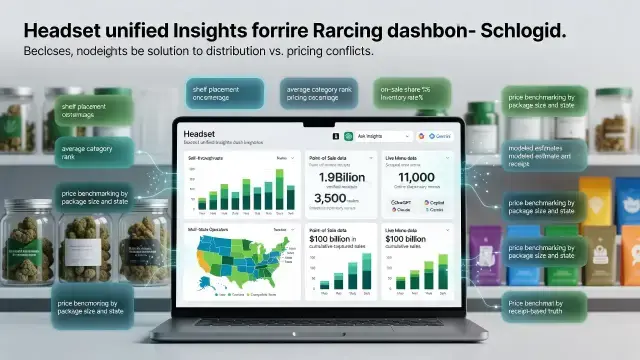
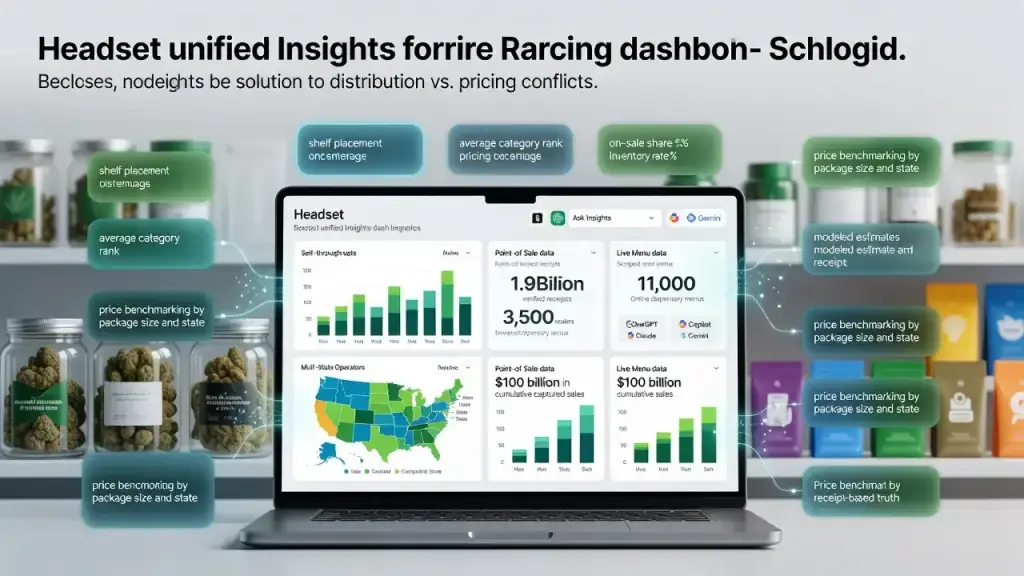
Headset has folded Menu Presence into its Insights platform at no additional cost, giving cannabis brands a view of their markets that previously required stitching together two separate tools. For the first time, subscribers can see verified point-of-sale figures next to live menu data - who carries their products, who carries the competition, and at what price - inside a single dashboard. The feature is live for every state a customer already subscribes to in Insights.
Why brands have been flying half-blind
Here's the operational problem this addresses. Menu-scraping tools tell a brand what's listed on a dispensary's shelf and at what price, but they say nothing about whether that product actually moved. Point-of-sale data does the opposite: it confirms what sold, SKU by SKU, but offers no window into shelf placement, competitor pricing, or which banners stock a rival line. A brand manager working from sales data alone might know a product is underperforming in a given state without ever learning that three of the top five MSOs in that market don't carry it at all. That's not a minor gap - it's the difference between a pricing problem and a distribution problem, and those get solved in very different ways.
Headset's answer is to put both data sets in the same place. The point-of-sale side draws on more than 1.9 billion retailer-approved sales receipts from upwards of 3,500 connected retailers. Menu Presence pulls daily from close to 11,000 online dispensary menus. Neither data set replaces the other; the value is in reading them together.
What changes for brand and category teams
In practice, a brand's category manager can now check average shelf rank inside a store's category, see what share of SKUs are listed on sale, and compare listed price against the broader market by package size and state - all while cross-referencing verified sell-through for the same products. That turns a gut-feel conversation about "where we're weak" into a data-backed argument about where to defend shelf space and where to walk away.
- Visibility into which stores, banners, and multi-state operators carry a brand versus its competitors, broken out state by state
- Category rank and on-sale share at the store level
- Price benchmarking by category, package size, and state
- Store-level drill-downs showing estimated daily sales and inventory on hand
Headset is also layering AI tools on top, available as add-ons: Ask Insights lets users query the platform in plain language, and an MCP Connector pipes Headset data into general-purpose assistants like ChatGPT, Claude, Copilot, Gemini, and others. For operators without a dedicated analytics staff, that lowers the skill floor needed to pull a useful answer out of a sprawling data set.
A caveat worth flagging
Menu Presence sales estimates are modeled from inventory movement, not pulled directly from point-of-sale receipts - Headset is explicit about that distinction, and it matters. The Sales tab remains the verified, receipt-based source of truth; Menu Presence is a daily-refreshed proxy for shelf conditions at stores that maintain an online menu, which still excludes a meaningful slice of brick-and-mortar retail in markets where menus aren't universal. Brands using this for wholesale negotiations or distribution planning should treat the estimates as directional rather than exact, particularly in states with thinner retailer counts or inconsistent menu publishing.
The release lands shortly after Headset said it passed $100 billion in cumulative cannabis sales captured across its connected retailer network as of October 2026 - a scale claim that, true or not independently audited by a third party here, at least signals the company is positioning this launch as a maturity milestone rather than a routine feature update. For brands and wholesalers trying to defend margin in an increasingly crowded adult-use and medical market, a combined view of shelf presence and verified demand is a meaningful upgrade over guessing from one data set alone.