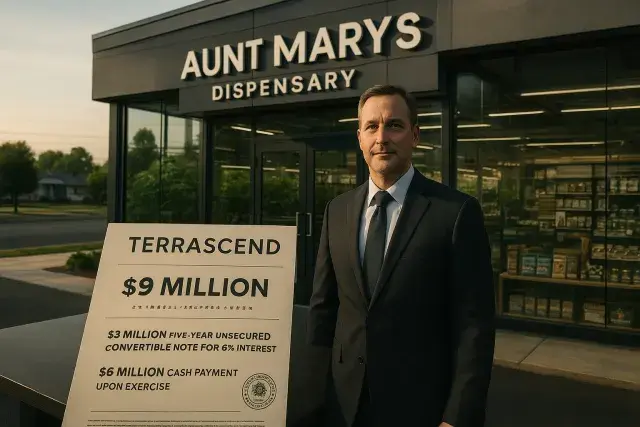
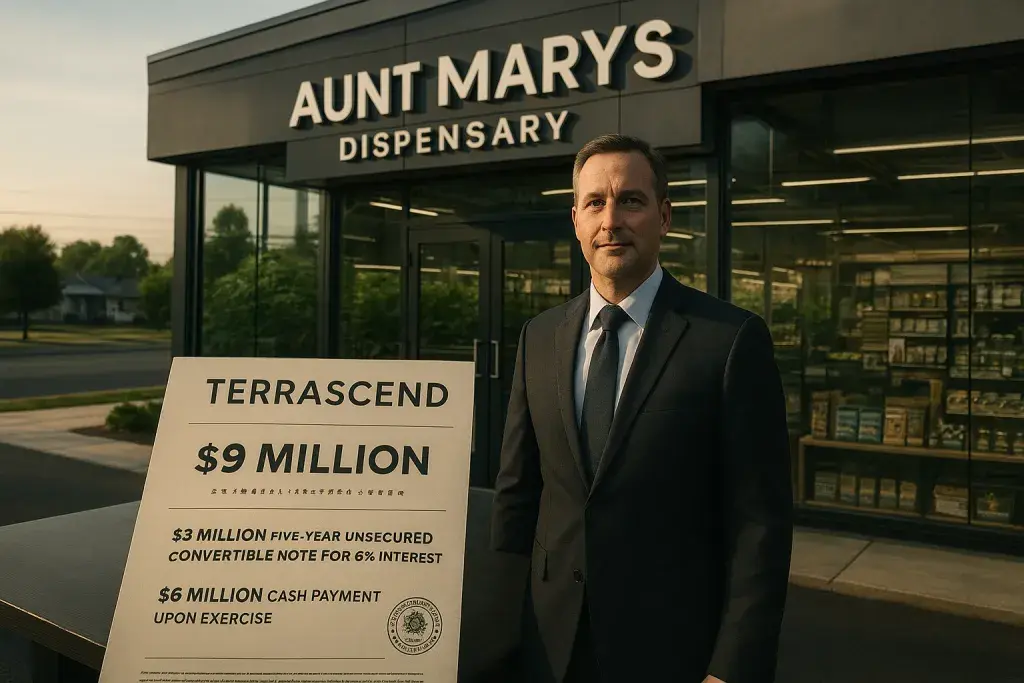
TerrAscend Corp. has signed an option agreement to purchase Aunt Mary's Dispensary LLC, a single-location operation in Flemington, New Jersey, for a total of $9 million - extending the multi-state operator's retail presence in the Garden State to five locations. The deal, announced June 30, 2026, is structured in two tranches: a $3 million five-year unsecured convertible note at 6% interest for a 35% stake option, followed by $6 million in cash upon exercise. TerrAscend expects the acquisition to be immediately accretive on an EBITDA and free cash flow basis.
The structure here is worth unpacking. Rather than an outright purchase, TerrAscend is using an option mechanism - a format that has become increasingly common in cannabis M&A precisely because it gives acquirers regulatory breathing room. Closing remains subject to New Jersey Cannabis Regulatory Commission approval, and using an option allows TerrAscend to lock in the asset without carrying full ownership risk during the approval window. That's a meaningful distinction in a state where license transfers can take months. Operators evaluating similar plays in other markets - from dispensary software in Michigan to multi-location retail expansions across the Northeast - increasingly look at deal architecture as a compliance instrument, not just a financial one. The convertible note component adds another layer: it gives TerrAscend a debt instrument that can convert to equity, which has its own implications for cap table management if regulatory timelines stretch.
Aunt Mary's opened in February 2023 and sits in a high-traffic retail corridor in Flemington, Hunterdon County. The location spans 5,200 square feet and carries what TerrAscend describes as limited nearby competition - a combination that goes a long way toward explaining the deal's appeal. At over $10 million in annualized revenue, the dispensary is generating meaningful volume for a standalone operation in a suburban market. Hunterdon County is largely rural relative to New Jersey's more densely populated corridors, which means Aunt Mary's likely pulls from a wide geographic catchment. In cannabis retail, that kind of de facto exclusivity in a licensed market is harder to manufacture than it sounds.
Vertical Integration Is the Real Margin Story
TerrAscend's executive chairman Jason Wild pointed directly to vertical integration as the path to margin improvement - and that's where the deal's real operational upside lies. Right now, Aunt Mary's operates as an independent retailer, sourcing product from wholesale suppliers across the state. Once TerrAscend takes control, it can begin routing its own cultivated and manufactured inventory - Kind Tree, Legend, Valhalla Confections, and Cookies - through the store's shelves. That shifts a portion of the wholesale margin captured by third-party brands back to TerrAscend itself.
In a vertically integrated cannabis operation, that math compounds quickly. A dispensary purchasing product from an outside wholesaler typically pays a markup that eats into retail margin. When the parent company controls cultivation and manufacturing, the "cost of goods" from an intercompany transfer is dramatically lower than an arm's-length wholesale price. The result is a wider gross margin at the store level - which, across a five-location New Jersey footprint, adds up. TerrAscend already operates scaled cultivation and processing facilities in its core markets, so adding Aunt Mary's to the distribution network doesn't require building new infrastructure. It's an incremental volume play on existing capacity.
New Jersey's Regulatory Framework and Social Equity Provisions
TerrAscend noted that the transaction conforms to New Jersey's regulatory framework for diversely owned businesses. That's not boilerplate. New Jersey's cannabis regulations include specific provisions governing how larger operators can engage with social equity and diversely owned licensees - including rules around investment, acquisition, and operational control. The CRC has built guardrails designed to prevent large multi-state operators from simply absorbing smaller, equity-licensed businesses outright on day one. The option structure in this deal - staged investment, convertible debt, phased control - tracks closely with how sophisticated operators have learned to work within those guardrails.
For dispensary owners in similar positions - a well-performing independent sitting on a valuable license and real estate footprint but lacking the capital or brand infrastructure of a larger operator - this deal type represents a genuine template. The seller retains involvement during the option period; the buyer gets operational influence and a path to full ownership; the regulator sees a transaction that follows the prescribed framework. It's not frictionless, but it's functional.
What This Signals for TerrAscend's New Jersey Strategy
Five licensed retail locations in a single state is a meaningful concentration. New Jersey's adult-use market has matured considerably since its 2022 launch, and competition has intensified as license approvals have accelerated. In that context, TerrAscend's willingness to pay $9 million for a single suburban store generating $10 million in annualized revenue - implying roughly a 0.9x revenue multiple - reflects a specific bet: that operational improvement through brand integration and vertical supply will lift both revenue and margin post-close.
Wild's comment about remaining "active in evaluating additional opportunities" signals that this isn't a one-off. TerrAscend operates across Pennsylvania, Maryland, Ohio, California, and Canada - a broad footprint that gives it brand assets, manufacturing capacity, and institutional knowledge to deploy at the retail level. The question for observers is whether New Jersey's regulatory environment continues to accommodate this kind of consolidation, and at what pace. The CRC has shown it will scrutinize multi-location MSO activity. Approval timelines, license transfer conditions, and any evolving rules around market concentration will all factor into how quickly TerrAscend can bring Aunt Mary's fully into its ecosystem.
One more thing worth noting: the federal rescheduling of marijuana from Schedule I to Schedule III - finalized by the DOJ on April 23, 2026, though limited in scope to FDA-approved products and state-licensed medical cannabis - does not resolve the compliance complexities facing adult-use operators. TerrAscend's own disclosure makes clear that adult-use cannabis remains a Schedule I substance under federal law, and that financial transactions involving cannabis proceeds still carry federal money laundering exposure. That legal overhang continues to shape deal financing, banking access, and investor risk profiles across the industry - regardless of how clean any individual transaction looks on its face.