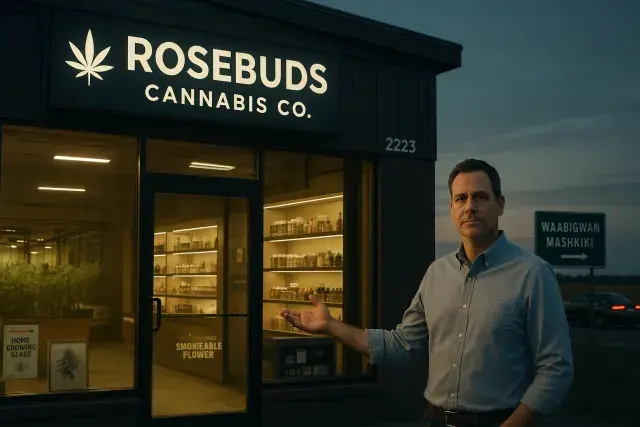
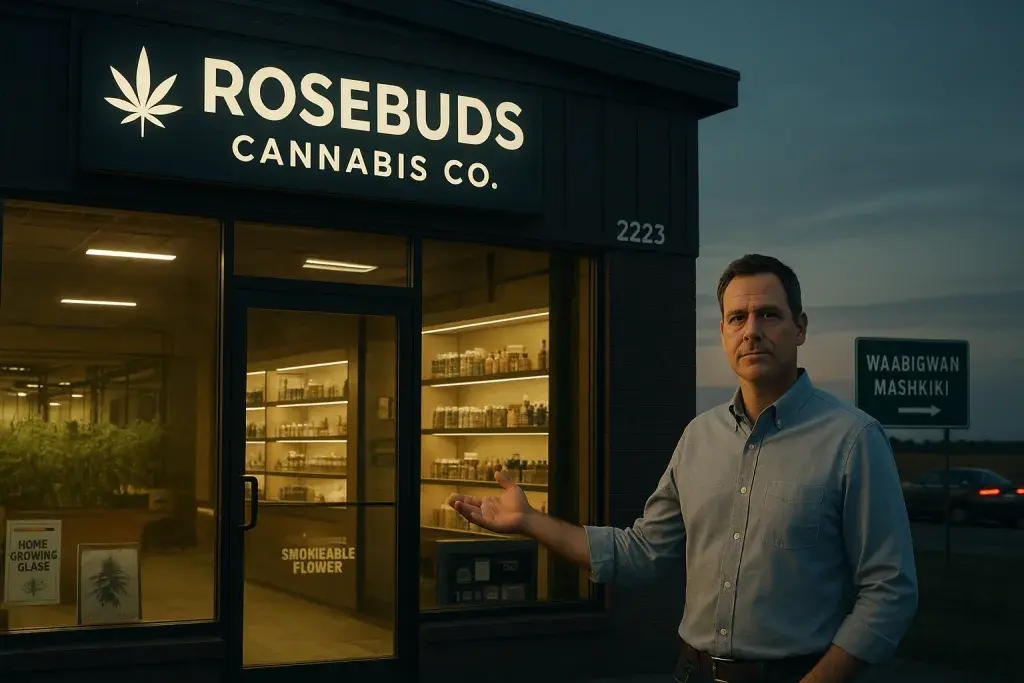
After more than a year of operating at the edge of insolvency, Steven Rosenfeldt finally received a state adult-use cannabis license in January for Rosebuds Cannabis Co., his dispensary at 2223 U.S. Highway 10 in Moorhead, Minnesota. The license came after a grinding stretch during which a tribally operated dispensary directly across the road - Waabigwan Mashkiki, run by the White Earth Nation - could legally sell the full range of adult-use products that Rosenfeldt could not. The gap in product authorization wasn't minor. It was existential.
Rosenfeldt, a former pharmacist, had been running the store under the name Ediblez OTC, a brand he has since retired in favor of Rosebuds Cannabis Co. The old name signaled edibles and little else - a liability in a market where inhalable products drive volume. Operators watching his situation would do well to recognize how much brand positioning matters at the retail level, especially when product mix is constrained by licensing status. Inventory management and customer communication tools - the kind of operational infrastructure supported by this dispensary POS - become especially important when a retailer is trying to hold onto customers with a limited SKU set while waiting on regulatory clearance.
The license unlocks a materially different product menu. Rosenfeldt can now carry smokeable flower, vapes, concentrates, wax, pre-rolls, and THC-infused beverages - products that were either prohibited or severely limited under his prior operating status. His per-serving THC cap has doubled from 5 milligrams to 10 milligrams, and the per-package limit has moved from 50 milligrams to 100 milligrams, putting him on equal footing with Waabigwan Mashkiki. "It's vape," he said flatly. "Vape is what people want." That's not a preference - it's a category reality that any dispensary operator tracking inhalable product sales already understands.
Supply Chain Constraints Are Squeezing the Shelves
The license, welcome as it is, doesn't solve Minnesota's upstream problem. A shortage of licensed cultivators is keeping wholesale menus thin, and the few private laboratories qualified to run compliance testing are under severe strain. One lab has already shut down. Before that closure, Rosenfeldt says the testing backlog already stretched six weeks - which means compliant product batches were sitting idle, unable to move to retail until a certificate of analysis cleared. That's inventory that doesn't exist as far as the salesfloor is concerned, and it keeps wholesale prices inflated well above what retailers in states with more mature supply chains are paying.
The contrast with Michigan is instructive. Michigan moved to unlimited licensing early in its adult-use rollout, and the resulting oversupply has pushed wholesale prices to some of the lowest levels in any regulated market. Minnesota, with its more cautious cultivator licensing posture, sits at the opposite end: constrained supply, stretched testing infrastructure, and retail prices that customers are noticing. "They're pretty disappointed with the price," Rosenfeldt says. That's a real risk for new adult-use markets - early-stage price points can shape consumer habits in ways that are hard to reverse, and some buyers will find workarounds if the regulated market feels inaccessible.
Advertising Limits Compound the Awareness Problem
Here's a constraint that doesn't get enough attention in licensing conversations: Minnesota's cannabis advertising restrictions mean that even a fully licensed dispensary has limited legal channels to tell the public what it sells. Rosenfeldt puts it plainly. "So many people still come in and they had no idea I was here. They had no idea I sell flower." For a store sitting on a busy U.S. highway, that's a striking failure of market awareness - and it's not a marketing problem he can solve with a billboard or a social media campaign the way most consumer retailers can.
This is a structural issue across regulated adult-use markets. Advertising restrictions modeled on alcohol-era rules tend to assume a level of consumer familiarity that doesn't yet exist in newly legal states. The result is a discovery gap: licensed, compliant operators running clean operations that consumers can't easily find. Small independent dispensaries feel this most acutely, since they lack the marketing infrastructure and brand recognition that multi-state operators bring into new markets from day one.
How Rosenfeldt Stayed Solvent - and What Comes Next
During the lean months before his license cleared, Rosenfeldt kept the business alive by selling seeds and teaching home-growing classes - a legal activity in Minnesota that gave him a revenue line and a customer relationship even when his retail menu was constrained. It's a pragmatic move, and one worth noting for any operator in a similar regulatory holding pattern: adjacent, compliant revenue streams can buy time when core licensing is delayed.
He is now cultivating roughly 100 cannabis plants hydroponically in a nearby warehouse, positioning Rosebuds for a degree of vertical integration that could reduce its exposure to wholesale price volatility. Whether that scales meaningfully depends on how quickly Minnesota's licensed cultivator count grows. Rosenfeldt expects a significant expansion within the next year, with corresponding downward pressure on wholesale prices. If he's right, the retail economics for independent dispensaries in the state should improve - though testing infrastructure will need to keep pace, or the bottleneck simply shifts rather than clears.
The story of Rosebuds Cannabis Co. is, in miniature, the story of every early-stage regulated market: a determined operator absorbing regulatory uncertainty, supply constraints, price pressure, and advertising restrictions all at once, while a tribally operated competitor with different authorization rules operates next door. The license helps. It doesn't fix everything.