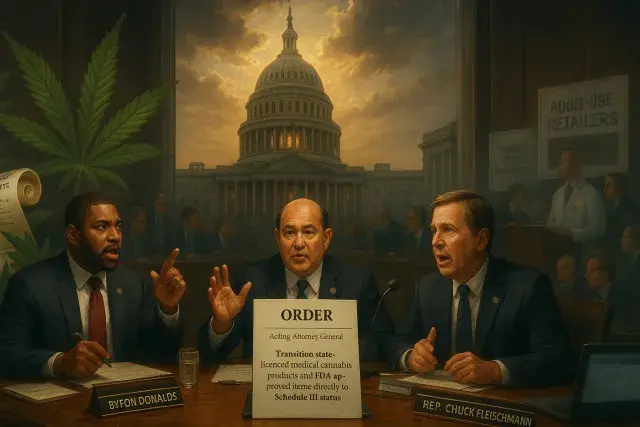

The second day of the Drug Enforcement Administration's administrative hearing on cannabis rescheduling turned confrontational in the most substantive way possible: opponents of marijuana reform pressed a Food and Drug Administration official on a recently revised analytical framework used to determine whether a substance has accepted medical use-and the official acknowledged, plainly, that cannabis could not have cleared the prior standard. That admission handed rescheduling critics a pointed argument while simultaneously revealing just how much weight the outcome of this proceeding will carry for every licensed cannabis operator in the country.
For dispensary owners and multi-state operators tracking this closely, the procedural stakes are hard to overstate. Rescheduling cannabis from Schedule I to Schedule III would reshape everything from federal tax exposure under 280E to banking access to how state-licensed businesses interact with federal contractors and financial institutions. Operators already running dispensary management software that integrates compliance tracking, seed-to-sale inventory, and reporting modules are watching this closely because a Schedule III designation would not automatically resolve state-federal friction-but it would change the operational risk calculation meaningfully, particularly around tax treatment and access to capital.
The FDA's acknowledgment about the prior "accepted medical use" test matters because it puts the agency's own methodological evolution directly in the crosshairs of the hearing record. Opponents are arguing, in effect, that the goalposts were moved to accommodate a predetermined outcome. That's a serious procedural challenge-and one that could fuel litigation regardless of how the DEA ultimately rules. Meanwhile, a separate government witness offered testimony that will be hard for regulators to ignore: cannabis's comparative safety profile relative to opioids was addressed in clinical terms, with that witness characterizing opioid withdrawal as "like a dumpster fire" and cannabis withdrawal as "more like a dying glowing ember of a campfire." It's a vivid distinction-and it lands in the hearing record at the same moment a new clinical study of chronic lower back pain patients found that inhaled cannabis was associated with what researchers described as "large, sustained, and statistically robust improvements in pain, disability, and pain interference, accompanied by near-total displacement of opioids, NSAIDs, antidepressants, and gabapentinoids." Concomitant opioid use in that study fell from 100 percent at baseline to 4.6 percent at year five. That kind of data doesn't resolve the legal question before the DEA, but it doesn't disappear from the record either.
State and Congressional Pressure Builds Around the Hearing's Edges
While the DEA proceeding occupies the federal spotlight, the surrounding political environment is anything but static. In Pennsylvania, every Democratic state senator signed a discharge resolution aimed at forcing a floor vote on a marijuana legalization bill that has stalled in a committee chaired by its own Republican sponsor-a maneuver that puts the GOP majority on record rather than allowing the bill to die quietly. Indiana is facing adjacent pressure: an op-ed from the Richard M. Fairbanks Foundation is calling on state officials to take a "thoughtful, data-informed approach" to cannabis law as neighboring legal markets come online. That kind of regional competitive pressure has historically been one of the more effective drivers of reluctant state legislative action.
On the federal side, the House Rules Committee is allowing a National Defense Authorization Act amendment to advance that would extend a military psychedelics research program-but proposals on marijuana test waivers for military recruits and Right to Try access to Schedule I substances are being blocked. The contrast matters for operators: psychedelics research is moving through the defense authorization process while cannabis-adjacent military personnel policies remain frozen. It's a useful reminder that federal cannabis reform is not a single front; it's a dozen separate policy levers being pulled at different speeds by different actors.
Market Signals Worth Tracking Now
A new consumer poll found that 77 percent of marijuana consumers said they are more likely to dine at restaurants offering THC beverages as an alternative to alcohol. That figure is relevant to licensed retailers because the THC beverage category-particularly products derived from hemp-sits in a genuinely ambiguous regulatory position while the White House is simultaneously pushing Congress to maintain federal hemp product legality. For dispensary buyers managing wholesale menus, the hemp-derived THC channel represents both a competitive threat and, depending on state law, a potential SKU category. How that tension resolves at the federal level will have direct shelf-level consequences.
On the business side, Tilray Brands is acquiring HelloMD, and TerrAscend has signed an option agreement to acquire Aunt Mary's Dispensary-consolidation signals that the M&A environment in cannabis is still moving despite the rescheduling uncertainty. Nebraska's attorney general signed off on medical cannabis regulations despite his personal opposition to reform, a reminder that professional obligation and personal position can occupy the same office. Colorado, Michigan, Maine, and Vermont regulators all published new guidance or pricing information in the same week. That's a lot of compliance updating for operators managing multi-state footprints-and a reliable argument for why real-time regulatory monitoring needs to be built into operational infrastructure, not treated as an occasional task.
What Operators Should Be Watching
The DEA hearing is not moving quickly, and the rescheduling timeline remains genuinely uncertain. What is clear: the FDA's acknowledgment that cannabis failed its prior medical-value framework will be litigated, appealed, and cited for years regardless of the final ruling. For licensed cannabis businesses, that means the federal compliance environment is not about to simplify-it's about to become more contested.
In practical terms, operators should be ensuring their seed-to-sale tracking, compliance documentation, and financial reporting are structured to accommodate rule changes rather than locked into assumptions about the current Schedule I status. The businesses that have built flexible operational infrastructure will have more room to respond. Those running on manual processes or outdated systems will find regulatory pivots significantly more expensive to absorb. The hearing is a policy event. Its downstream consequences are an operations problem.