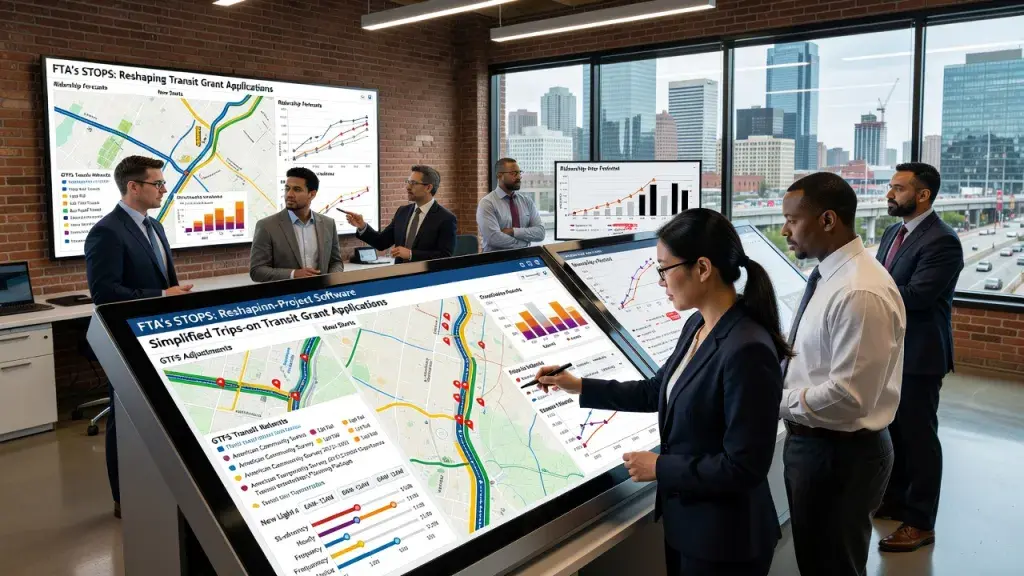
Transit agencies pursuing federal capital funding now have a lighter-weight path to ridership forecasting. The Federal Transit Administration's Simplified Trips-on-Project Software, known as STOPS, gives New Starts and Small Starts sponsors an optional method to generate the ridership and travel-time measures FTA uses to evaluate and rate proposed projects. It's not mandatory, but for many small and mid-sized agencies, it's become the practical choice.
A Stripped-Down Alternative to the Classic Four-Step Model
Traditional travel demand modeling runs on the conventional four-step process: trip generation, trip distribution, mode choice, and traffic assignment. STOPS keeps that basic architecture but swaps out two of the most labor-intensive steps. Instead of building custom trip generation and distribution models from scratch, STOPS pulls directly from 2012-2016 American Community Survey tabulations in the Census Transportation Planning Package to characterize regional travel markets. It also replaces hand-coded transit networks - historically one of the more tedious and error-prone parts of the process - with standard General Transit Feed Specification data, the same GTFS format that powers most transit-app trip planners riders already use.
That substitution matters. GTFS data is publicly available, regularly updated, and already maintained by transit agencies for other purposes. Sponsors aren't building a network model in isolation; they're repurposing infrastructure that already exists.
What Sponsors Actually Have to Do
Choosing STOPS isn't a one-click decision. Project sponsors need to assemble several pieces before forecasting can begin:
- Obtain STOPS documentation and software directly from FTA
- Pull the relevant Census Transportation Planning Package data
- Gather supporting inputs from the region's existing travel model
- Secure current GTFS data for the metro area
- Adjust that GTFS data to reflect the proposed New Starts or Small Starts project itself, since baseline GTFS won't include a line that doesn't exist yet
That last step is where judgment comes in. Modifying transit feed data to represent a not-yet-built project requires someone who understands both the software and the operational plan for the new service - frequency, stops, span of service, and how it interacts with the existing network.
Validation Behind the Model
FTA didn't build STOPS in a vacuum. Calibration and validation drew on detailed rider surveys from eight metro areas and station-level count data from nine others - fifteen regions total, covering 24 fixed-guideway systems. That mix included six commuter rail lines, one heavy rail system, thirteen light rail systems, two bus rapid transit corridors, and two streetcar lines. In practice, that breadth gives the tool a reasonable claim to applicability across different transit modes, though sponsors evaluating unusual corridor conditions should still treat outputs with appropriate scrutiny rather than assuming automatic transferability.
Time, Staffing, and Where to Get Help
FTA's own estimate: local installation and data assembly takes a capable travel-forecasting professional one to two weeks. Producing actual project forecasts adds another week for straightforward corridors, or two to three additional weeks where the project or the local transit market is more complicated. That's a meaningful staffing commitment for smaller agencies without a dedicated modeling shop on staff.
The upside is that sponsors aren't left to sort it out alone. STOPS generates the full suite of reporting sponsors need to review ridership forecasts in detail and to support grant applications. And FTA provides direct technical assistance - after working through the User Guide, installing the software, and making real progress toward a forecast, sponsors can reach out to FTA's Jeff Roux for questions or to request help from an FTA-provided contractor. For agencies weighing whether STOPS fits their project, that support channel is often the deciding factor.