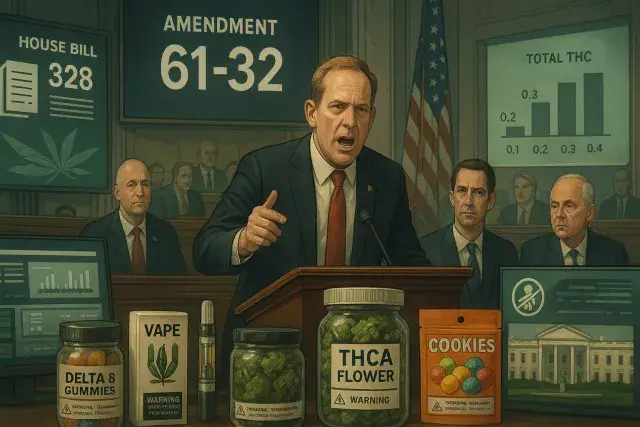
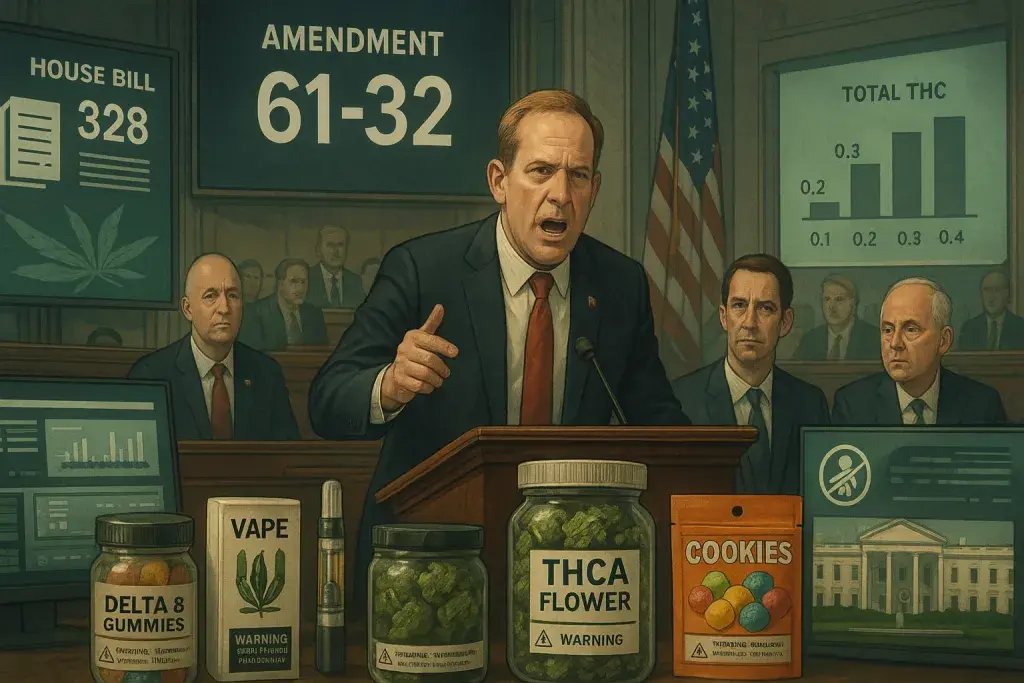
A one-month reprieve for intoxicating hemp products survived a Senate floor fight last week, but the underlying fight over how much THC belongs on convenience store shelves is far from settled. Sen. Ted Budd, R-NC, tried to strip a delay provision out of the government funding bill that would have let sweeping federal hemp restrictions take effect Nov. 12 as originally scheduled. His amendment failed 61-32, meaning the restrictions now kick in Dec. 11 instead - a 30-day cushion that hemp retailers, brands, and multi-state operators watching the space will take, but shouldn't mistake for a resolution.
For dispensary operators in states with regulated adult-use and medical markets, this whole fight might look like someone else's problem. It isn't. The federal definition change reshapes total THC accounting across every hemp-derived product category - beverages, gummies, vapes, delta-8, THCA flower - and that ripples into wholesale supply chains, compliant packaging standards, and how retailers stock adjacent product lines. Operators tracking inventory through seed-to-sale systems already know how quickly a shift in allowable cannabinoid thresholds can turn a compliant SKU into a liability overnight. States building out their own regulatory infrastructure, including markets served by platforms like an oklahoma dispensary pos system, are watching closely because point-of-sale and compliance logging tools need to adapt fast when federal thresholds move underneath a state's existing framework.
What The Federal Hemp Standard Actually Changes
The law Congress passed in November 2025 redefines hemp based on total THC rather than delta-9 THC alone, and it caps finished hemp-derived products at 0.4 milligrams of combined THC and similar cannabinoids per container. That's a dramatically lower bar than what's currently sold in gas stations and smoke shops nationwide under the old delta-9-only framework. Budd's argument, delivered from the Senate floor, leaned hard on child safety - citing North Carolina emergency department data showing cannabis-related visits among minors rose sharply between 2017 and 2025, and pointing to packaging that mimics candy and snack brands. Whether or not lawmakers agree on the fix, the packaging issue alone has become a consumer-protection flashpoint that regulated cannabis retailers, who already operate under strict labeling and child-resistant packaging rules, have dealt with for years.
A White House At Odds With Its Own Party
The dispute exposed a real split inside Senate Republican ranks, and it wasn't subtle. Budd, Sen. Pete Ricketts, and Sen. Tom Cotton pushed for letting the restrictions take effect on schedule; the White House, through legislative affairs official James Braid, told senators in a closed-door lunch that no further extension was coming after this one. CMS Administrator Dr. Mehmet Oz separately urged senators to preserve the delay, warning that immediate implementation could disrupt access to full-spectrum hemp-derived CBD for seniors and people with disabilities - an argument Budd publicly rejected as unrelated to the intoxicating-product problem he was targeting. A 105-organization coalition, including the US Hemp Roundtable and the National Association of Convenience Stores, backed the delay, arguing an extra month gives Congress room to legislate manufacturing standards and import controls rather than impose a blunt threshold.
North Carolina's Own Deadlock Mirrors Washington's
North Carolina lawmakers are stuck on nearly identical terrain. House Bill 328 would write the same 0.4-milligram total THC limit directly into state law, independent of whatever Congress ultimately does - meaning the state prohibition could stand even if the federal delay stretches further or gets rewritten entirely. The Senate passed a conference report 37-6 in July, but the House hasn't taken it up, and Speaker Destin Hall says he's forming a smaller working group to keep negotiating before year's end. For hemp retailers and compliance teams in the state, that ambiguity is the real operational headache: no clean effective date, no settled product list, and inventory decisions that have to be made without knowing which threshold ultimately governs the shelf.
The larger lesson for regulated cannabis retail is less about hemp specifically and more about how quickly adjacent regulatory categories can shift underneath an operator's business model. Dispensary owners have lived under strict THC limits, COA requirements, and age-verification rules for years; the hemp industry is now getting a compressed version of that same reckoning, playing out in real time on the Senate floor.