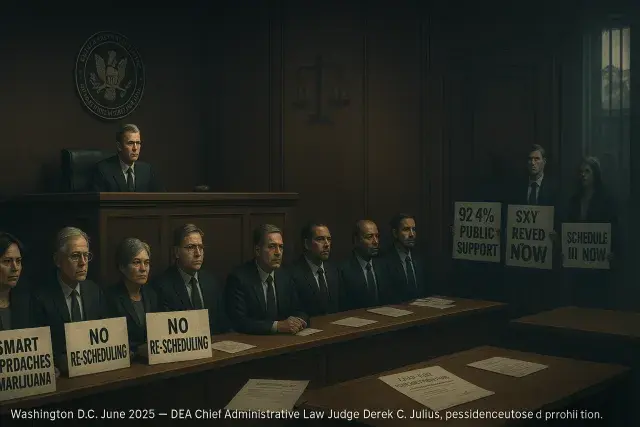
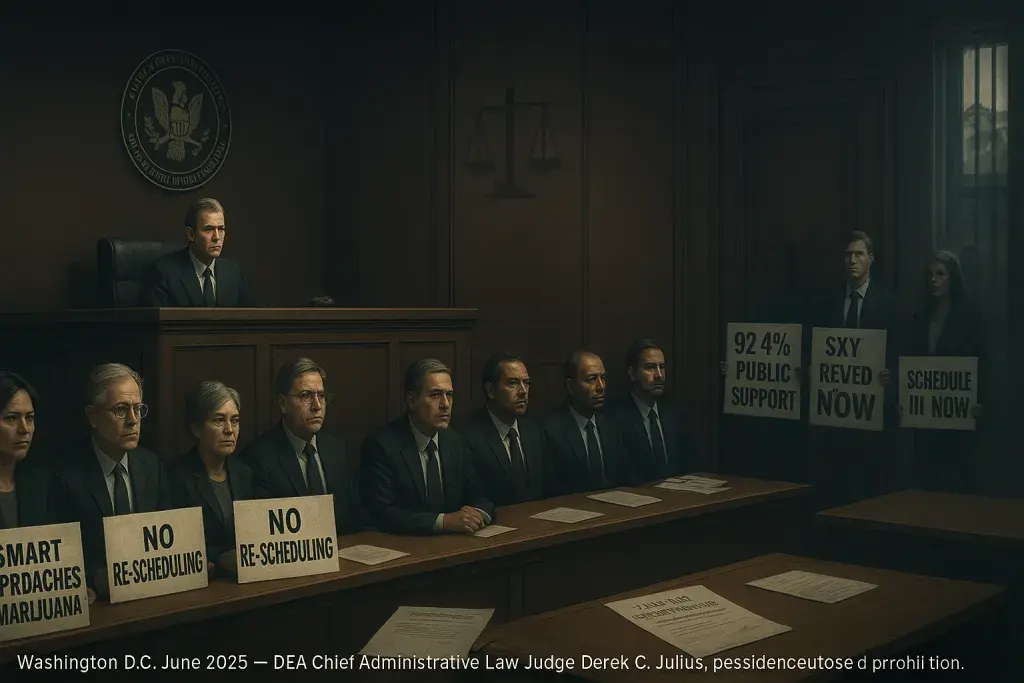
The Drug Enforcement Administration has structured its upcoming administrative law judge hearing on cannabis rescheduling in a way that is, to put it plainly, unprecedented: seven anti-rescheduling parties invited, zero pro-rescheduling parties accepted. The hearing, scheduled to run from June 29 through no later than July 15, is supposed to build a factual record on whether cannabis should be transferred from Schedule I to Schedule III under the Controlled Substances Act. Instead, that record will be constructed entirely from prohibitionist testimony, despite the fact that 92.4% of the roughly 43,000 public commenters on the proposed rule either supported the Schedule III transfer or wanted the DEA to go further.
For licensed cannabis businesses - multistate operators, single-location dispensaries, wholesale distributors, and the vendors who service them - the hearing's outcome carries direct operational weight. A Schedule III determination would not legalize cannabis, but it would remove cannabis from the most restrictive federal classification, potentially easing certain federal banking, research, and tax-treatment barriers. State-licensed retailers in markets with active regulatory frameworks already run compliance-heavy operations: seed-to-sale tracking, METRC reporting, compliant packaging, and sophisticated point-of-sale infrastructure. Dispensary operators in states like Virginia, who already manage multilayered compliance obligations through tools like a dispensary pos system Virginia providers support, know well that federal scheduling status shapes everything from insurance access to payment processing options. A final rule that lands at Schedule II rather than Schedule III - or stays at Schedule I - would leave the most consequential federal barriers in place.
The DEA's rationale for excluding every pro-rescheduling applicant rests on a narrow reading of "interested person" under 21 CFR 1300.01(b): someone "adversely affected or aggrieved" by any rule "issuable" from the proceeding. In rejection letters obtained by Cannabis Business Times, DEA Administrator Terry Cole dismissed arguments from cannabis businesses that they could be harmed if the agency ultimately issued a Schedule II rule rather than Schedule III. Cole's position was that speculative harm from a future, undetermined regulatory outcome falls outside the hearing's scope. That sounds like a coherent legal argument until you sit with it for a moment - because the hearing notice itself uses the word "issuable," which on its face encompasses any rule the DEA could issue, not just the specific Schedule III transfer proposed. Pro-rescheduling applicants read that word and built their standing arguments around it. The DEA read the same word and rejected every one of them.
A Structural Problem With the Record Being Built
Administrative law hearings under the Administrative Procedures Act exist precisely to create an adversarial record - competing evidence, rebuttal testimony, cross-examination - so that a presiding judge and, later, reviewing courts have something substantive to evaluate. The ALJ hearing format is not a comment box. It is supposed to generate friction between opposing expert views. Strip out one side entirely, and what you have is less a fact-finding exercise than a one-directional presentation. The anti-rescheduling parties invited to participate include Smart Approaches to Marijuana, the National Drug & Alcohol Screening Association, DUID Victim Voices, the states of Nebraska, Idaho, Indiana, and Louisiana, Dr. Kenneth Finn, the Tennessee Bureau of Investigation, and pharmacist Phillip A. Drum. Two of those last two entities - the Tennessee Bureau of Investigation and Drum - were previously selected under the prior Biden-era hearing process, one that was later withdrawn after pro-rescheduling participants accused the DEA of improper ex parte communications with anti-rescheduling parties.
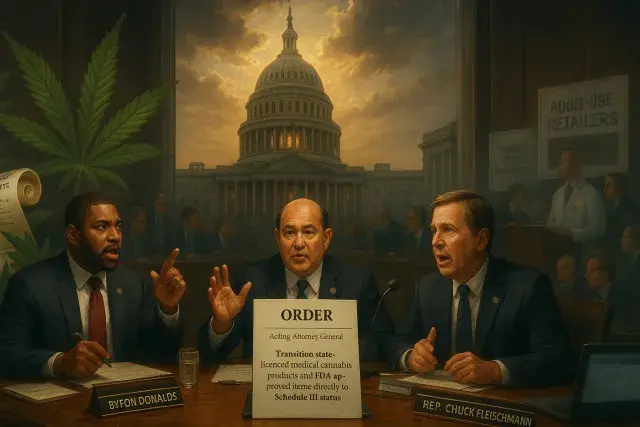
What's missing from this lineup is any voice capable of contesting the prohibitionist testimony with evidence that cannabis has "currently accepted medical use" in the United States - which is, notably, one of the central factual findings underpinning the proposed rule itself. That finding, if left unrebutted in the record, creates an evidentiary gap that future litigation could exploit regardless of which direction the final rule moves. DEA Chief ALJ Derek C. Julius noted in a June 18 preliminary order that the DEA "as the proponent of the proposed rule, has the burden of proof." But the proposed rule also states clearly that the DEA has not yet made a final determination on the appropriate schedule for cannabis. That ambiguity, combined with the fact that Acting Attorney General Todd Blanche - not DEA Administrator Cole - signed the order establishing the new expedited hearing, raises real questions about where institutional support for the proposed rule actually sits within the current administration.
Why Licensed Operators Should Watch the Record, Not Just the Outcome
The immediate business instinct is to focus on the binary: does cannabis move to Schedule III or not? But for operators, investors, and compliance professionals, the administrative record produced by this hearing may matter as much as the final determination. A lopsided record - one built entirely on anti-rescheduling expert opinion, with no rebuttal from medical professionals, researchers, or industry stakeholders who support reform - creates a documented evidentiary foundation that courts will review. If the DEA issues a final rule to reschedule cannabis and that rule is subsequently challenged, the thinness of the record on the pro-rescheduling side could become a liability. If the DEA declines to reschedule, or issues a more restrictive rule, the absence of adversarial testimony could equally be used to challenge the process as procedurally deficient.
Researchers at Johns Hopkins University and the University of California San Diego published findings in late April showing that the overwhelming majority of public comments supported reform - 29.8% backing the Schedule III proposal as written, 63.5% wanting more substantial change, and only 6.7% opposing any reclassification. Public comment periods are not binding votes, and the DEA is not required to follow majority opinion. But the stark contrast between that public record and the hearing's guest list is the kind of procedural asymmetry that courts and congressional oversight committees tend to notice.
What Comes After the Hearing
The hearing concludes no later than July 15. After that, the ALJ will issue a recommendation, and the DEA administrator will make a final scheduling determination - a determination that will almost certainly face legal challenge no matter which direction it goes. For cannabis businesses operating in licensed state markets, the posture to take now is one of informed vigilance rather than operational restructuring based on anticipated outcomes. 280E tax exposure, limited access to traditional banking, restricted payment processing options, and federal employment drug-testing conflicts all hinge, at least partially, on federal scheduling status. None of those structural pressures resolve automatically with a Schedule III designation - but some ease, and licensed operators need to understand the distinction.
The more uncomfortable question sitting underneath all of this is whether the DEA's selection process was designed to produce a particular kind of record rather than a genuinely adversarial one. That question may never be answered cleanly in the public record. But it will almost certainly be argued in federal court.