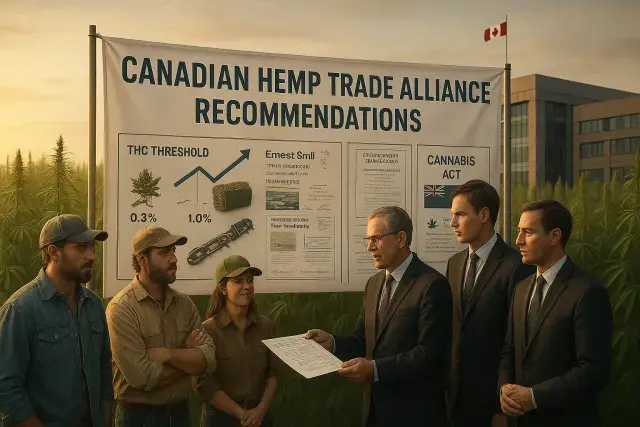
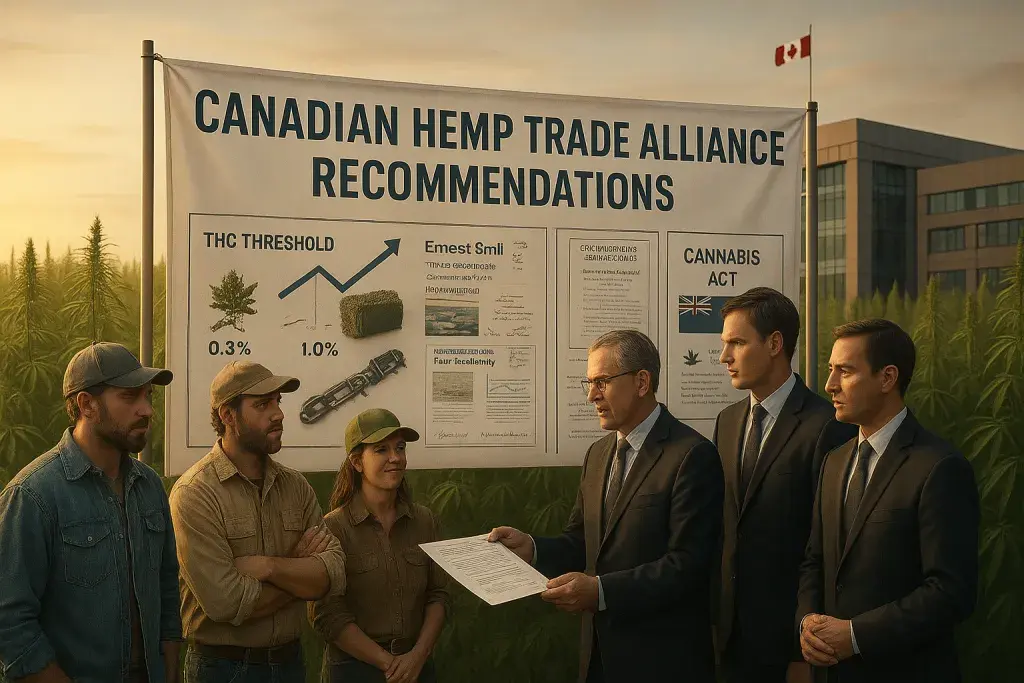
The Canadian Hemp Trade Alliance has submitted a sweeping set of recommendations to Health Canada that would, if adopted, represent the most significant overhaul of Canada's industrial hemp regulations since the late 1990s. The proposals - filed as part of a federal consultation Health Canada launched in May - call for tripling the allowable THC threshold, dismantling most licensing requirements, and opening commercial markets for hemp flowers and biomass. The consultation window closes June 30, and any resulting regulatory changes are still at least 12 to 24 months away.
For licensed hemp operators, the stakes are concrete. Current rules treat hemp cultivation much like a controlled substance - with licensing, reporting and permit requirements that comparable field crops simply do not face. That compliance burden shapes everything from grower economics to export pricing to product development timelines. Operators in other regulated agricultural sectors, including some cannabis-adjacent businesses that rely on tools like marijuana pos software alaska to manage inventory and compliance across state lines, will recognize the dynamic: when regulatory frameworks are designed for narcotics control rather than agricultural commerce, the paperwork load rarely stays proportional to the actual risk.
The CHTA's most visible ask is raising the maximum allowable THC concentration in hemp flowers and leaves from the current 0.3% to 1.0%. The 0.3% benchmark has a specific origin - it was developed by Canadian hemp researcher Ernest Small in the 1970s and has since been widely adopted internationally. Small himself has publicly described the threshold as arbitrary and has expressed support for a higher limit. The CHTA submission leans on that history directly, arguing the standard no longer reflects either the science or the commercial realities of modern hemp agriculture. New Zealand recently adopted a 1.0% limit as part of broader reforms that also eliminated grower licensing requirements, giving the Canadian proposal an active international precedent rather than a hypothetical one.
What the CHTA Actually Wants - and Why the Distinctions Matter
The recommendations go well beyond the THC threshold. On hemp flowers and biomass, the alliance argues that all plant parts should be treated as agricultural commodities unless they are being processed into concentrated cannabinoids. That's a meaningful line to draw. Under that framework, a grain or fiber operation selling raw floral biomass would face no more regulatory friction than a canola farmer selling grain - but a processor extracting phytocannabinoids would still require a Cannabis Act license. The intent is to separate hemp agriculture from cannabinoid extraction cleanly, something the current rules do not do.
That distinction also has a market-stability dimension. Hemp-derived intoxicating products - primarily those produced from CBD converted into delta-8 THC - have caused significant confusion in U.S. hemp markets and have begun affecting how buyers and regulators perceive hemp products more broadly. The CHTA's approach of maintaining licensing controls specifically at the extraction stage, rather than at the farm gate, reflects an awareness that regulatory clarity on that point protects legitimate hemp businesses as much as it protects consumers.
The alliance also recommends transferring management of Canada's List of Approved Cultivars from Health Canada to the Canadian Seed Growers' Association. The current system, CHTA argues, is slow and unpredictable - a structural barrier to breeding programs at a time when new cultivars suited to fiber co-harvest and floral biomass production are commercially important. More broadly, the submission recommends shifting general industry oversight to Agriculture and Agri-Food Canada, the Canadian Food Inspection Agency and Statistics Canada, rather than leaving it primarily under a health regulatory framework built for narcotics control.
The Regulatory Logic - and Where It Gets Complicated
The CHTA frames much of its argument around international obligations. The 1961 Single Convention on Narcotic Drugs is the treaty most countries cite when justifying hemp licensing requirements. But the CHTA submission references recent guidance from the International Narcotics Control Board and a 2024 United Nations Trade and Development review, both of which reportedly encouraged governments to reconsider treating industrial hemp primarily as a narcotics issue. That's not a settled debate - regulators in many countries continue to maintain licensing systems regardless of industrial intent - but it gives the CHTA's argument a multilateral anchor rather than a purely domestic one.
Here's the catch, though. Health Canada oversees hemp under the Cannabis Act, a framework that was built to manage both recreational and medical cannabis alongside industrial hemp. Pulling hemp agriculture out from under that structure - or even partially reassigning oversight - requires interagency coordination, updated legislative authority, and a clear answer to the question of where the line between agricultural hemp and extractable cannabinoids actually sits in practice. Those aren't paperwork problems. They're structural ones, and they explain why the timeline for any changes runs well past the consultation period.
What Growers, Processors and Investors Should Track
The consultation itself is the immediate action item. Health Canada specifically requested stakeholder input on THC testing protocols, reporting requirements, flower sales permissions, import and export controls, and cultivar list management - which maps almost exactly to the CHTA's submission. That alignment suggests the agency is genuinely open to revisions, not just running a procedural exercise.
Regulatory changes adopted earlier in 2025 - which eliminated THC testing requirements for many hempseed products and removed restrictions on certain hemp food ingredients - show that Health Canada has already been moving in a deregulatory direction on hemp, even within the existing framework. The CHTA is pushing for something larger: a reclassification of how hemp is regulated at the conceptual level, not just adjustments to individual rules.
For growers, the 1.0% THC threshold would open access to cultivars better suited to fiber and flower co-harvest - improving the economics of operations that currently have to choose between fiber yield and biomass value. For processors and exporters, unrestricted sales of raw hemp flowers and biomass would reduce the compliance cost of sourcing material. For seed developers and breeders, the proposed transfer of cultivar approval to an agricultural body would - in theory - accelerate the time between varietal development and commercial availability. None of that is guaranteed. But the regulatory direction, if the CHTA recommendations gain traction, is toward treating hemp as the agricultural commodity its proponents have always argued it is.