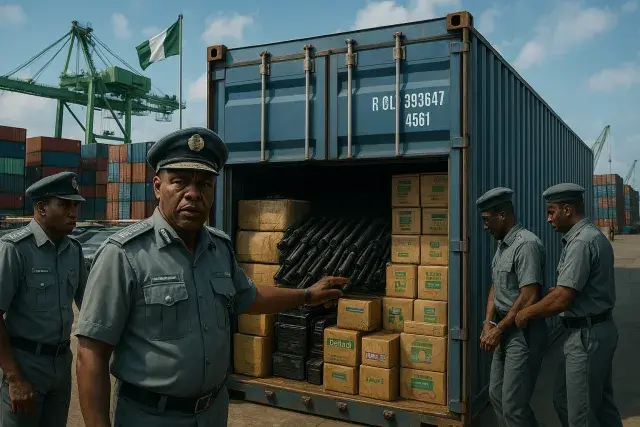
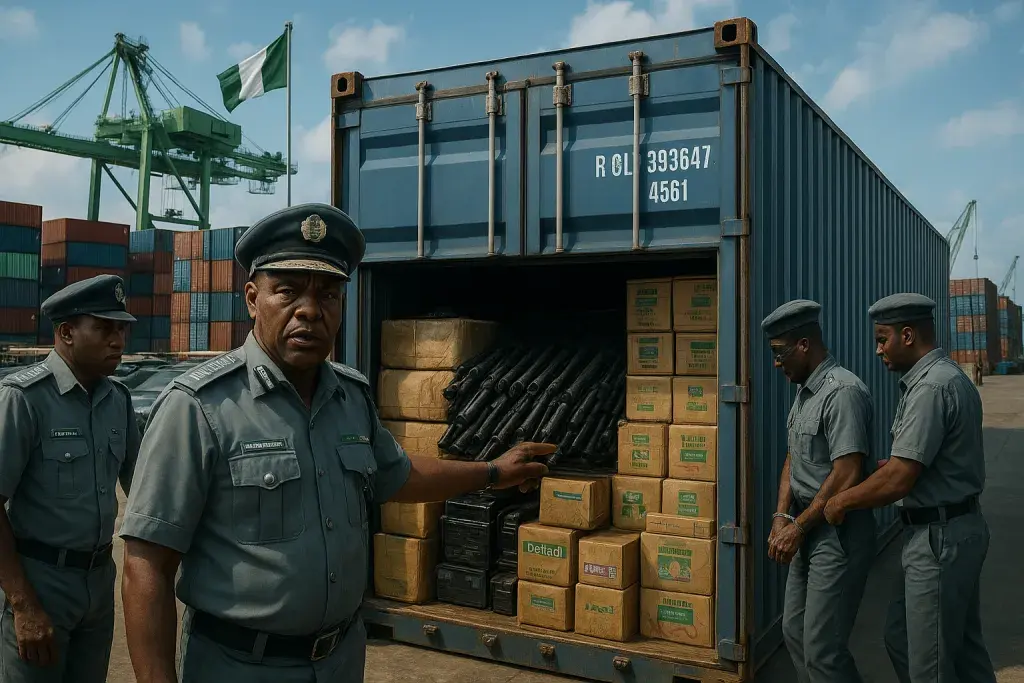
Nigeria Customs Service officers at the Tincan Island Port Command have intercepted a shipping container concealing knocked-down components for more than 140 pump-action rifles, alongside a separate haul of cannabis-infused products valued at over ₦373.8 million. Comptroller General Adewale Adeniyi disclosed both seizures on Thursday, framing them as evidence of a broader pattern: organized networks embedding contraband inside routine import manifests to slip past border controls.
The firearm parts arrived aboard MV VELIKA on 8 July 2026 and were flagged by the Service's intelligence-driven risk management system before physical examination confirmed the concealment. Two suspects are in custody; a third remains at large. For compliance teams across regulated industries, the case is a reminder that risk profiling only works when it's paired with physical inspection discipline - a lesson that applies just as much to inventory audits inside a licensed cannabis retail operation as it does to a customs yard. Retailers managing high-volume SKU counts, whether through a legacy ledger or a modern platform like cannabis pos virginia operators use to track batch movement, know that traceability gaps are where diversion and contraband both tend to hide.
The second interception involved two 40-foot containers carrying cannabis-infused cookies, gummies and pre-roll products hidden among used vehicles, generators and batteries. Customs recorded 109 cartons of Delta-8 pre-roll cookies, 125 cartons of Delta-8 gummies and 73 cartons of cannabis-infused cookies, together valued at ₦373,802,640. Cannabis remains tightly restricted in Nigeria, and products of this kind have no lawful retail channel in the country - meaning any commercial movement of them constitutes smuggling rather than a regulatory gray area.
Why This Matters Beyond Nigeria's Borders
What's striking here is the packaging profile: Delta-8 gummies, pre-roll cookies, branded cartons - products manufactured to resemble legitimate consumer goods sold in regulated adult-use markets elsewhere. That resemblance is precisely the problem. In jurisdictions with functioning cannabis retail frameworks, compliant packaging, child-resistant seals, batch numbering and lab-tested COAs exist to protect consumers and give regulators a paper trail. When those same product formats surface in a market with no licensing structure to test, tax or track them, there's no COA to check, no lab result to verify potency, and no accountable manufacturer if something goes wrong. That's not a technicality - it's a consumer-safety gap with real consequences.
For multi-state operators and brands watching global enforcement trends, the episode underscores a supply-chain reality that compliance officers already know well: legitimate trade lanes are attractive precisely because they're legitimate. Concealing contraband inside used vehicles, generators or standard containerized freight works only as long as inspection rates stay low or predictable. Adeniyi's warning that "men of the underworld" may test Nigeria's ports and airports ahead of the election cycle is a straightforward acknowledgment that enforcement resourcing tends to loosen under political and logistical strain - and that criminal networks plan around that seasonality.
Operational Lessons for Regulated Markets
Fair enough, Nigeria's enforcement posture and licensing vacuum are a different animal from the state-regulated cannabis markets in the U.S. or Canada. But the underlying mechanics travel. Seed-to-sale tracking, manifest audits, and risk-based inspection protocols exist in regulated markets for the same reason customs flagged that container: pattern recognition catches what routine paperwork review misses. Operators building out compliance programs - whether for point-of-sale reconciliation, delivery manifest verification, or wholesale intake - are running a smaller-scale version of the same intelligence-driven model Customs described.
- Concealment inside legitimate cargo categories (vehicles, appliances, batteries) remains a persistent smuggling tactic worth flagging in supply-chain risk assessments.
- Products mimicking regulated market packaging can mislead consumers into assuming testing and oversight exist where none do.
- Enforcement gaps widen around major political events, a pattern relevant to any jurisdiction tightening or loosening oversight around elections or budget cycles.
- Traceability systems only add value when physical verification backs up the data - a principle as true in a dispensary backroom as at a port terminal.
Adeniyi's pledge to pursue accomplices within the Service itself also speaks to a compliance truth that regulated cannabis operators recognize: internal controls matter as much as external enforcement. Diversion, whether of firearms or cannabis products, rarely succeeds without some failure of oversight along the chain of custody. That's the through-line connecting a customs seizure in Lagos to inventory shrinkage audits in a licensed dispensary - the mechanics of catching it look remarkably similar wherever the product happens to be.