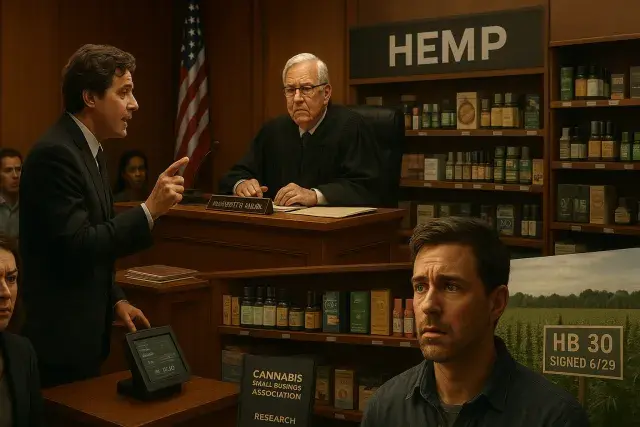
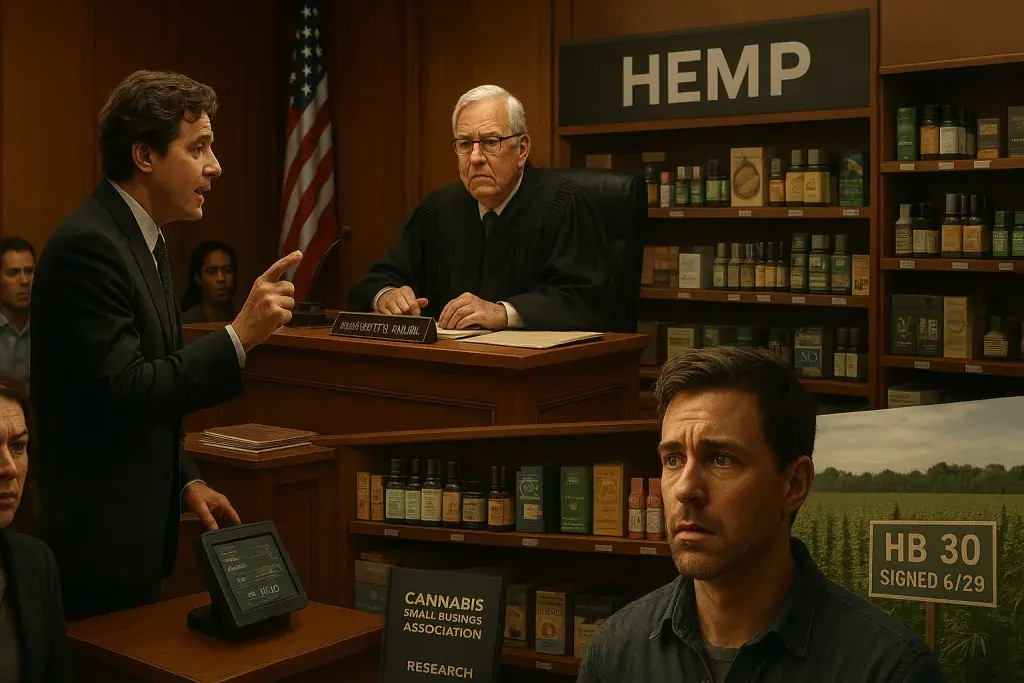
A federal judge spent nearly five hours Wednesday weighing whether to pause Virginia's new hemp restrictions before they take effect Saturday, as store owners testified that the changes could wipe out inventory overnight and push small operators out of business. Seven Virginia hemp businesses are asking U.S. District Judge Robert S. Ballou for a temporary injunction blocking enforcement of House Bill 30, which eliminates the state's 25-to-1 CBD-to-THC exception and caps most hemp products at two milligrams of total THC per package. Attorney Chap Petersen, who represents the plaintiffs, said he expects a decision by Friday.
The case lands at a moment when hemp-derived cannabinoid retail has quietly become a significant piece of Virginia's small-business economy, operating in a regulatory gray zone that many states are now moving to close as they build out licensed adult-use marijuana markets. That transition creates real friction for operators who built compliant businesses under one set of rules only to face a hard cutoff under another. It's a dynamic playing out well beyond Virginia - retailers in states with newer regulated markets have had to overhaul everything from product formulation to checkout systems, the kind of operational lift that touches point-of-sale infrastructure just as much as it touches the sales floor. Systems built for a market like Oklahoma, where dispensaries rely on point-of-sale for Oklahoma dispensaries to track compliant SKUs and manage shifting product categories, illustrate how quickly back-end retail technology has to adapt when regulators redraw the line on what counts as a legal product.
What the Rule Change Actually Does
Before HB 30, Virginia allowed hemp products to skirt the state's THC threshold if they carried a CBD-to-THC ratio of at least 25 to 1. That exception let manufacturers formulate products with detectable total THC as long as CBD content dominated the mix. The new law scraps that carve-out entirely and imposes a flat two-milligram total-THC-per-package limit for most products, regardless of CBD content. In practice, that reclassifies a large share of existing shelf inventory - products that were fully legal on Aug. 14 - as unlawful to sell the moment the clock strikes midnight. Petersen argues that timeline is the core problem: Gov. Youngkin didn't sign the bill until June 29, leaving businesses roughly six weeks to liquidate or reformulate inventory built on agricultural cycles that don't move that fast.
Inventory Risk and the Compliance Cliff
For hemp retailers, this isn't a simple matter of swapping suppliers. Hemp is an agricultural commodity - crops planted in April, harvested around October, then processed into finished goods with a defined shelf life and no alternate use once manufactured. Unlike a piece of equipment that can be relocated across state lines, a harvested and processed hemp batch that no longer meets Virginia's THC threshold has essentially no legal outlet. That's the compliance cliff Moorefield and other plaintiffs described: product legal one day, a potential felony liability the next, with no clear guidance from the state's cannabis regulatory agency on what to do with stock caught in between. For operators anywhere, that kind of abrupt reclassification is the nightmare scenario - compliant inventory becoming non-compliant not through any operator error, but through a legislative switch flipped with little lead time.
What's at Stake for the Broader Market
Beyond the individual retailers, the lawsuit points to a wider economic footprint tied to hemp-derived cannabinoid sales in Virginia, according to industry-cited research referenced by the Cannabis Small Business Association. Whatever the court decides, the case highlights a recurring tension as states pivot from loosely regulated hemp markets toward tightly controlled adult-use cannabis systems: lawmakers moving to close loopholes often do so faster than the supply chain - growers, manufacturers, wholesalers, and retailers - can absorb. An injunction wouldn't resolve the underlying constitutional question, which Petersen says could head to trial early next year if the General Assembly doesn't revisit the law first. But it would buy operators time to sell down inventory, adjust wholesale relationships, and lobby for a legislative fix rather than face immediate closure.